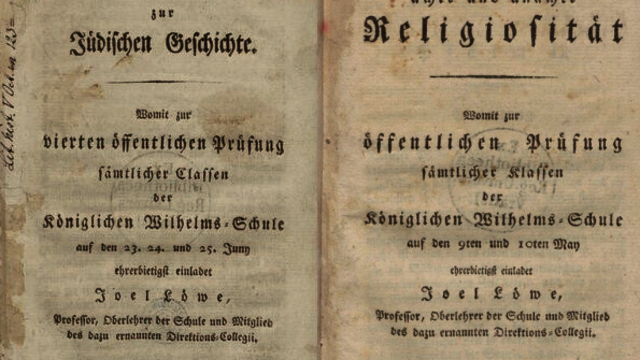


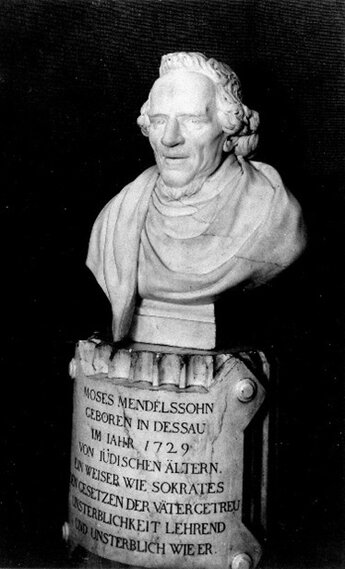
The exhibition not only pays tribute to one of the most significant philosophers of the late German Enlightenment and the most prominent figure of the Haskalah (Jewish Enlightenment). It also aims to explore and present to the public Mendelssohn’s diverse friendships and family ties to Hamburg. The objects brought together in the exhibition will narrate and illustrate this specific chapter of Hamburg’s history, placing it within the context of the Jewish Enlightenment movement and early Reform Judaism.
The exhibition brings to life the memory of Moses Mendelssohn as a representative of a religious and cultural minority facing legal and social discrimination, who confronted his opponents and critics not as a victim of his circumstances, but as an active agent. It aims to showcase the personal story of a Jewish scholar, characterised by constructive engagement with people of other faiths and differing views on an equal footing. Mendelssohn earned great respect amongst the intellectuals of the Enlightenment for his steadfast defence of Judaism against the calls for him to convert to Christianity. Unlike what is usually emphasised in the biographies of Jewish men, Mendelssohn’s life was a Jewish success story that was not characterised by economic success.
A central aim of the exhibition is also to highlight the significance of the Haskalah as a Jewish modernisation and educational movement with supra-regional networks, which, originating in Berlin, also influenced Jewish intellectual life in the Hamburg area. As part of the exhibition’s development, these influences and repercussions are being researched in detail. The aim is also to highlight that Reform Judaism, which originated in Hamburg, had its roots in the Haskalah – aspects that have scarcely been taken into account in research to date.
The theme of the exhibition is, on the whole, rich and multi-layered. Consequently, the exhibition will focus on exploring further important aspects of Hamburg’s history, such as welfare for the poor and Jewish philanthropy, as well as education, with a particular emphasis on the education of Jewish girls. Finally, the exhibition aims to convey the values associated with the (Jewish) Enlightenment, values epitomised in particular by the figure of Moses Mendelssohn. These are universal values that remain relevant to this day and are once again gaining social significance. They include tolerance towards other religions and minorities, humanity, a willingness to engage in dialogue with those who hold different views, combating prejudice, the search for truth (in a world of misleading fake news), openness to modernisation and scientific progress, the relevance of the arts, and much more.
Picture 1: Jean Pierre Antoine Tassaert: Büste Moses Mendelssohn. Gips 1785. Gidal Bildarchiv. Salomon Ludwig Steinheim-Institut, Essen. Inventar-Nr. 0978.
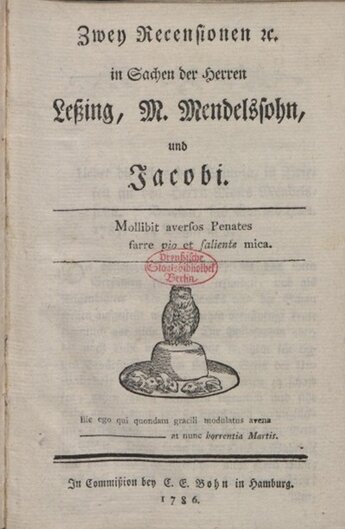
Picture 2: [Asmus:] Zwey Recensionen [et]c. in Sachen der Herren Leßing, M. Mendelssohn und Jacobi. Hamburg 1786. Staatsbibliothek zu Berlin – Preußischer Kulturbesitz, Berlin. Signatur: Nl 13608.
https://digital.staatsbibliothek-berlin.de/werkansicht/?PPN=PPN84741504X
The project is funded, amongst other sources, by grants from the Monika Richarz Fund of the Institute for the History of German Jews and the ZEIT STIFTUNG BUCERIUS, as well as the Hamburgischen Wissenschaftlichen Stiftung.