

IGdJ launches NFDI4Memory Incubator Fund project with the University of Erfurt and Erfurt University of Applied Sciences
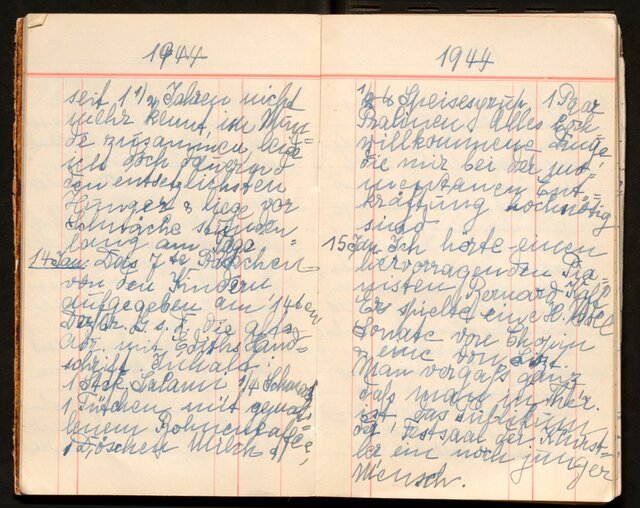
“What a pity that I may not confirm to the children what indescribable joy their packages cause & how necessary they are to an underfed body.” These lines were written by Martha Glass, a Jewish woman from Hamburg, in her diary on May 11, 1943, during her imprisonment in Theresienstadt. They express self-assertion and joy in the face of the children's signs of life, as well as despair and worry in the face of uncertainty and her own health situation. Is AI capable of recognizing these complex and ambivalent emotions?
Eyewitness accounts are important sources of historical events and provide insights into individual lives and experiences. Testimonies from Holocaust victims are essential for research because they document events and perspectives that are not included in official documents or perpetrator reports, or are only distorted. They are also a central component of remembrance culture. Autobiographical testimonies are becoming particularly important in light of the much-discussed end of eyewitness testimony and the recent search for new forms and points of reference.
AI has been used for several years now to prepare interviews with contemporary witnesses for outreach work, and the question of the influence and impact of AI is also increasingly being asked with regard to the evaluation of written personal accounts.
The aim of the project, which is funded by NFDI4Memory as part of the Incubator Funds 2026, is to contribute to a critical reflection on the functioning and application scenarios of AI-supported analysis methods with regard to the evaluation and interpretation of personal accounts of the Holocaust and its aftermath, against the backdrop of the growing importance of such methods. The project investigates the potential of existing tools and machine-based methods using the example of sentiment analysis and emotion-based or emotional history approaches, which are discussed in both educational work and research. Using the diaries of Theresienstadt survivor Martha Glass, lexicon-based approaches and machine learning methods are tested and evaluated in order to open up new avenues for historical research. The project thus provides important impetus for digital source criticism and the reflective use of methods and tools in working with personal accounts. The project's procedures and results are also being prepared for teaching and educational purposes.
The research project “Sentiment analysis between insight and distortion? A case study of eyewitness accounts of the Holocaust and its aftermath” is a collaboration between the Institute for the History of the German Jews and the inter-university Chair of Digital Humanities at the University of Erfurt and the University of Applied Sciences Erfurt.
Picture: Martha Glass ― Theresienstadt Diaries 1943-1945, Key Documents of German-Jewish History