


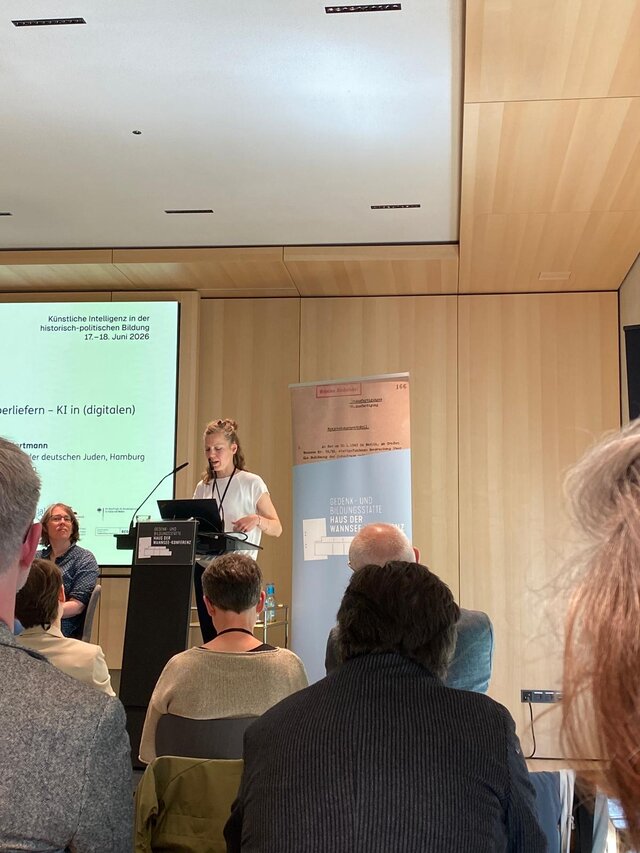
Presentation by Dr. Anna Menny on the IGdJ’s digital projects
On June 17 and 18, 2026, the conference “Does AI Write History? Artificial Intelligence in Historical and Political Education” took place. It was organized together with the DAAD Center for German Studies at Hebrew University of Jerusalem and kulturBdigital, Technologiestiftung Berlin. Representatives from the fields of historical and political education, research institutions, and libraries reflected on and discussed the potential, challenges, and limitations of using AI-based methods in research, cataloging, and educational projects.
Anna Menny, who attended the conference on behalf of the IGdJ, attempted to enrich these discussions—drawing on the IGdJ’s many years of experience in the field of #DigitalJewishHistory—by offering additional perspectives from her own research. In her opening remarks during the panel discussion “Preserving, Cataloging, Transmitting—AI in (Digital) Archives,” she provided an overview of the use of digital methods at the IGdJ and emphasized that the discussion regarding the impacts of digitization in the field of history—and specifically in the field of Jewish history—already has a (long-standing) history. In the current debate on AI, she noted, this history is sometimes given too little attention, obscuring the fact that there is already existing experience and expertise regarding the critical evaluation of digital sources and methods. She further highlighted both the potential and the challenges associated with the digitization of source material and the growing influence of computer-assisted methods and data-driven research approaches. In particular, the current project “Sentiment Analysis: Between Insight and Distortion? A Case Study of Self-Testimonies on the Holocaust and Its Aftermath,” funded by the Incubator Fund (NFDI4Memory) and carried out in cooperation with the Chair of Digital Humanities at the University of Erfurt and the University of Applied Sciences Erfurt, demonstrates the importance of carefully reflecting on the assumptions and decision-making since they have an impact on the results of the analysis. In order to reveal gaps and distortions and to be able to contextualize the results of the AI-based methods, the greatest possible transparency must be ensured regarding the decision-making processes, the data set, and the methodological and technical prerequisites. Only then can AI, beyond simply streamlining specific work steps, open up a space for critical reflection and engagement with the production of historical knowledge and historical narratives.
The extent to which AI itself becomes a generator of new perspectives and approaches—or rather, reproduces and prolongs established methods, narratives, and perspectives under new technical conditions—is—alongside the many interesting project presentations and stimulating ideas from the conference—an important impetus for further reflection in our own work at the IGdJ.
Conference programme House of the Wannsee Conference below
Photo: Nina Zellerhoff
Cutout Graphic Recording, © Mathis Eckelmann